Ethereum to Base USDC bridge


Moving $1,000 USDC from Ethereum to Base costs about $1.02 in fees and typically arrives in ~1 min with Fast Transfer. Circle's CCTP mints native USDC on Base: no wrapped token, no slippage, and no ETH needed for gas in a sendstables wallet.
- Fees on $1,000
- about $1.02Quote checked Oct 21, 2026
- Arrives in
- ~1 min (Fast Transfer)~15–19 min if Fast Transfer is unavailable · Avg. attestation ~20s
- Delivery
- Native USDCBurn and mint via Circle CCTP


How your money is secured
- Non-custodial. Funds stay in your own wallet: an embedded wallet secured by Privy, or the wallet you connect. We never hold your keys.
- Fees fixed at confirm. The price is signed when you confirm; nothing extra is taken later.
- Native USDC. Circle's CCTP burns USDC on one chain and mints it on the other. No bridges, no wrapped tokens.
- Every step on-chain. You get explorer links for each transaction and a shareable status page.
- Circle's CCTP burns USDC on Ethereum and mints the same amount on Base. No pool, no wrapped token.
- You see the total fee and the guaranteed minimum you'll receive before you sign.
- Independent app built on Circle's public CCTP; not operated by Circle. How transfers are protected →
What it costs
Full fee schedule →| You send | Total fees | Arrives on Base (est.) |
|---|---|---|
| 100 USDC | $0.53 | 99.4745 USDC |
| 1,000 USDC | $1.02 | 998.9845 USDC |
Fee previews from our live quote API, checked Oct 21, 2026, 8:02 PM UTC. The app shows the current fee and the guaranteed minimum before you confirm. Check the current quote
Fee breakdown, method and data
| You send | sendstables fee | Circle fees (est.) | Total fees (est.) | You receive (est.) |
|---|---|---|---|---|
| 100 USDC | 0.4605 | 0.065 | 0.5255 | 99.4745 |
| 1,000 USDC | 0.8605 | 0.155 | 1.0155 | 998.9845 |
All values are USDC, rounded for readability. Checked Oct 21, 2026, 8:02 PM–Oct 21, 2026, 8:02 PM UTC. These expired, unsigned previews are historical observations, not a current price or a quote you can execute. No funds were moved to collect them.
- No recipient given: priced for the user's own Base wallet.
- Fees track live gas and Circle fees; the final quote is shown in the app before the user confirms.
~1 min (Fast Transfer) is the app's estimated end-to-end arrival time, not a measured result from these observations. Circle's published average Fast Transfer attestation from Ethereum is ~20 seconds; destination minting still follows. If Fast Transfer is unavailable, Circle's standard-transfer attestation average is ~15–19 minutes. See Circle's timing methodology.
Download the exact quote observations. Licensed under CC BY 4.0: credit sendstables, link the license and indicate changes (attribution and scope).
How the fee is calculated
| Part | Rate | Notes |
|---|---|---|
| sendstables fee | 0.05% service charge (min $0.10, no cap) plus operating costs and margin | Operating costs and margin are added to the service charge. Our exact fee is in the quote. |
| Circle Fast Transfer fee | ~1 bps (0.01%) | Circle's fee for Fast Transfer from Ethereum; an estimate. |
| Circle Forwarding Service | about $0.06 per transfer | Circle submits the mint on Base; Circle's estimate when checked; the app shows the live fee before you confirm. |
| Your gas | $0 | No ETH needed in a sendstables wallet. A connected EVM wallet pays its own source-chain gas. |
- Operating costs with a 30% margin are added to the service charge. Circle's fees and the amount received are estimates; the app shows live figures and the guaranteed minimum before you confirm.
- If Circle's Fast Transfer allowance is used up, it settles as a standard transfer instead (Circle's standard attestation average from Ethereum: ~15–19 minutes).
- Circle's Forwarding Service fee is Circle's estimate when checked; the app shows the live fee before you confirm.
- A connected EVM wallet (instead of your sendstables wallet) pays its own ETH gas on Ethereum.
How it works
- BurnYour USDC is burned by Circle's CCTP contract on Ethereum.
- AttestCircle's attestation service signs the burn.
- MintThe same amount of native USDC is minted on Base.
More about Ethereum → Base
Ethereum supports CCTP V2 Fast Transfer, so Circle attests the burn after soft finality instead of waiting for full finality. If Circle's Fast Transfer allowance is used up, it settles as a standard transfer instead, with Circle's standard attestation average from Ethereum at ~15–19 minutes. From Ethereum to Base, USDC typically takes about 1 minute with Fast Transfer (Circle's average attestation from Ethereum: ~20 seconds), or longer if Circle's Fast Transfer allowance is used up (Circle's standard-transfer attestation average from Ethereum: ~15–19 minutes); Circle's Forwarding Service submits the mint on Base.
On Ethereum, with your sendstables wallet the fee payment, approval and burn are gas-sponsored, so you don't need any ETH for gas — just the USDC you're sending. If you connect your own EVM wallet instead, it pays the ETH gas for those transactions. On Base, Circle's Forwarding Service submits the mint for you, so the recipient doesn't need any ETH for gas on Base.
CCTP burns and re-mints instead of using a pool, so there's no slippage and no wrapped token. Learn about CCTP.
How to move USDC from Ethereum to Base
- Sign in. Sign in with a one-time email code; no password is needed. You get a wallet on EVM chains, Solana and Stellar, with no seed phrase.
- Have USDC on Ethereum. Deposit USDC on Ethereum or use what's there. In your sendstables wallet you don't need any ETH for gas.
- Pick the route. On Swap chains, pick Ethereum → Base and enter the amount. To pay someone else, use Send and paste their address.
- Review the quote. Check our fee, Circle's fees and the minimum you'll receive. The fee is fixed once you confirm.
- Confirm. USDC is burned on Ethereum, Circle attests it, and native USDC is minted on Base.
Before you send
- Ethereum mainnet and Base can share the same 0x… address, but their USDC balances are separate. Select Ethereum as the source and Base as the destination before reviewing the quote.
- Hold native USDC on Ethereum. A token named USDC, USDC.e or a bridged version is not automatically the Circle-issued asset; compare the identifier below.
- Use a 0x… wallet address that can receive native USDC on Base. The same address format is used on many EVM networks, so confirm Base with the recipient.
- Sending to an exchange? Check it accepts native USDC deposits on Base, and that it doesn't need a memo or tag the form can't add.
Native USDC identifiers on Ethereum and Base
Ethereum: 0xa0b86991c6218b36c1d19d4a2e9eb0ce3606eb48
Base: 0x833589fCD6eDb6E08f4c7C32D4f71b54bdA02913
These identify the token or issuer, not an address to send funds to. Compare with Circle’s official mainnet registry.
See the Ethereum → Base quote form
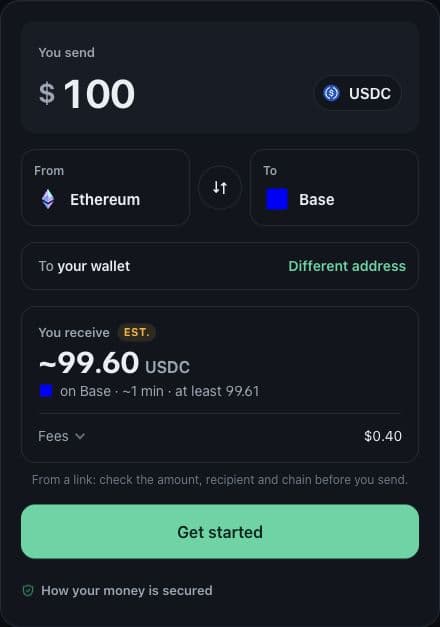
Open a 100 USDC example for Ethereum → Base. The link fills the form only; sign in and review the live quote to continue.
Or ask your AI agent
MCP setup →Connect Claude, Cursor or any MCP client and ask. It moves USDC within limits you set.
- “Move 50 USDC from Ethereum to Base.”
Show the MCP tool call
{
  "name": "swap_chains",
  "arguments": {
    "from": "Ethereum",
    "to": "Base",
    "amount": "50",
    "idempotency_key": "ethereum-to-base-0001",
    "max_fee_usd": 1
  }
}
FAQ
How much does it cost to move $1,000 USDC from Ethereum to Base, and how long does it take?
Moving $1,000 USDC from Ethereum to Base with sendstables has a service charge of $0.50 (0.05% at this amount) plus about $0.16 in Circle fees, about $0.66 combined before operating costs and margin. It arrives as native USDC minted by Circle's CCTP (no wrapped token) and typically takes about 1 minute with Fast Transfer (Circle's average attestation from Ethereum: ~20 seconds), or longer if Circle's Fast Transfer allowance is used up (Circle's standard-transfer attestation average from Ethereum: ~15–19 minutes), with no ETH needed for gas in a sendstables wallet. Estimates checked Oct 23, 2026; the in-app quote shows our exact fee, Circle's live fee estimate and the guaranteed minimum you'll receive.
How long does it take to move USDC from Ethereum to Base?
It typically takes about 1 minute with Fast Transfer (Circle's average attestation from Ethereum: ~20 seconds), or longer if Circle's Fast Transfer allowance is used up (Circle's standard-transfer attestation average from Ethereum: ~15–19 minutes). Times are estimates.
How much does it cost to bridge USDC from Ethereum to Base?
Our fee is 0.05% service charge (min $0.10, no cap) plus operating costs and margin (the cost margin is 30%). Circle adds its Fast Transfer fee from Ethereum: ~1 bps (0.01%) when checked, plus a small Forwarding Service fee on Base. The quote shows our exact fee, Circle's live fee estimate and the guaranteed minimum you'll receive before you sign.
Is the USDC I receive on Base native or wrapped?
Native. CCTP burns USDC on Ethereum and Circle mints the same amount on Base. No wrapped token, no pool, no slippage.
Do I need ETH on Ethereum for gas?
Not with a sendstables wallet: we sponsor the ETH gas. A connected EVM wallet pays its own ETH gas. Circle's Forwarding Service handles the mint on Base.
Can I send USDC from Ethereum to someone else's Base address?
Yes. Use the Send tab and paste a 0x… address (any EVM wallet or exchange deposit address that accepts native USDC on Base). The Swap tab moves USDC between your own wallets.
Is sendstables run by Circle?
No. sendstables is an independent app built on Circle's public CCTP. Circle issues USDC and runs CCTP; we sponsor gas, relay where needed, and charge the fee shown in the quote.
Troubleshooting Ethereum → Base
My USDC balance is missing
Check the sending wallet, selected network (Ethereum) and token identifier above. Native USDC on Base or another network is a separate balance. If you hold a bridged token, this route does not convert it into native USDC for you.
After a recent deposit, check its confirmation in your wallet’s explorer and refresh the app balance.
The address or destination is rejected
Use a 0x… wallet address that can receive native USDC on Base. The same address format is used on many EVM networks, so confirm Base with the recipient.
Copy it again from the recipient’s wallet, check the full address and confirm the network. Do not use a token contract, mint or issuer address as the recipient.
The quote changed or I cannot confirm
Review the refreshed quote and the USDC balance on Ethereum. Network costs and Circle fees can change, and expired quotes cannot be confirmed.
If you connected an external EVM wallet, it also needs ETH on Ethereum for source-chain transactions. A sendstables wallet uses sponsored gas.
If a wallet prompt was rejected, check the app’s transfer status before trying again.
The burn confirmed but USDC has not arrived on Base
Open the existing transfer’s status and explorer links. Delivery follows the source burn, Circle’s attestation and the destination mint; a confirmed burn alone does not mean delivery is complete. Use the app’s status or delivery retry controls when offered.
If Fast Transfer is unavailable, Circle’s published standard-transfer attestation average from Ethereum is ~15–19 minutes. Destination minting follows that step; this is an average, not a delivery deadline.
Avoid starting a second transfer to fix a pending one. Circle explains attestation and finality times.
The transfer says delivered, but my wallet does not show USDC
Check the destination transaction and recipient on Base. Select Base in the receiving wallet and, if needed, add the native USDC token identifier above to its display. For an exchange deposit, its own crediting process may still be pending.
For help, keep the route, source transaction hash, destination hash if available and the status or error message. Never share a seed phrase, private key or sign-in code. Contact sendstables support.
Instructions checked 2026-10-15 UTC against the sendstables app. See how transfers are protected and the remaining risks.


